
- 8 May 2026
- Posted by: EYATH S.A.
- Category: All News
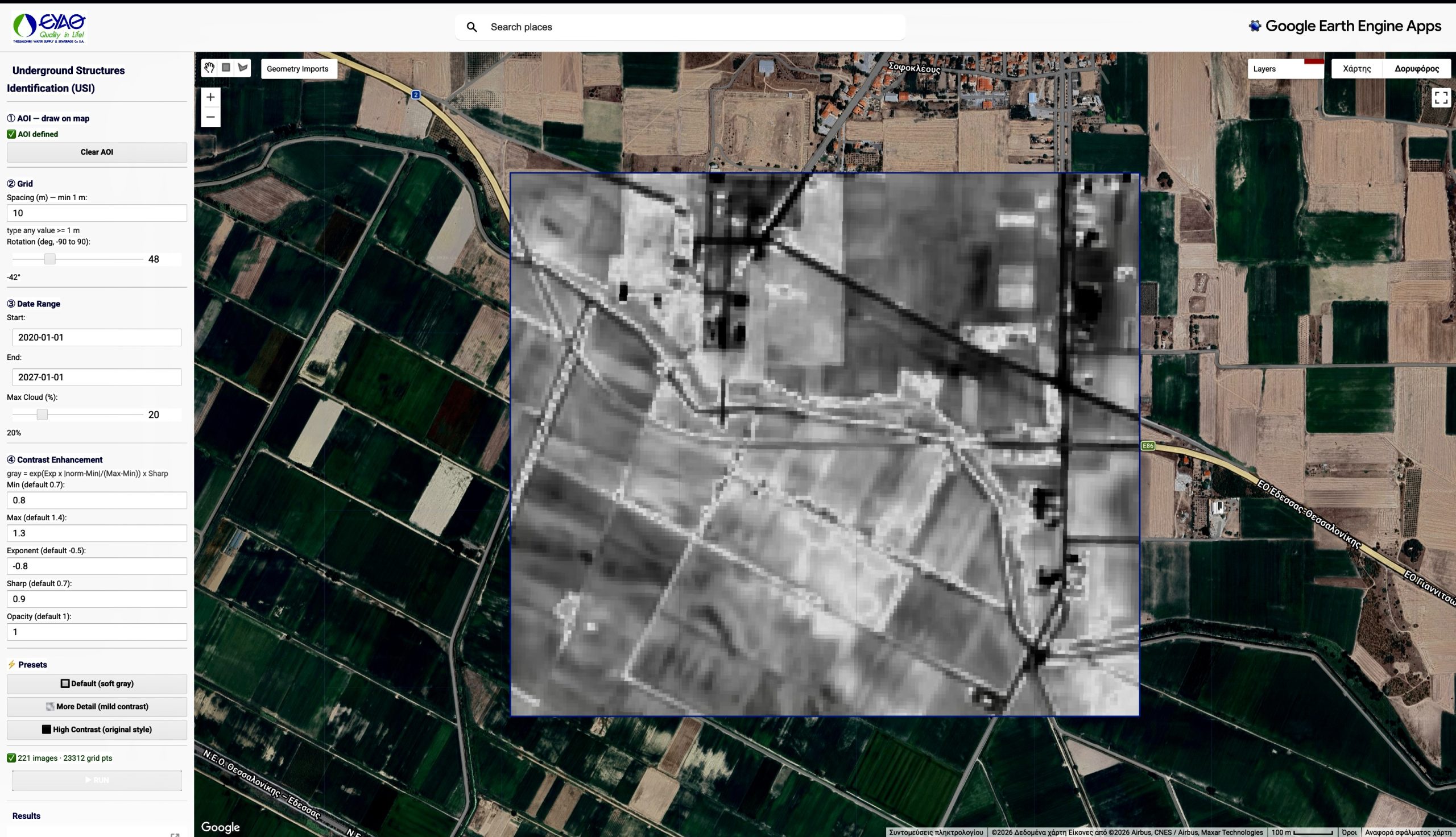
EYATH’s patented technology—originally designed for detecting leaks in underground pipelines—was deployed at the archaeological site of Pella in collaboration with the Ephorate of Antiquities of Pella; this time, however, the aim was to detect signs of buried archaeological structures!
EYATH’s patented technology—which holds a national patent and is currently undergoing international protection procedures via a PCT application—was applied in Pella, one of Greece’s most significant archaeological sites. The goal was the non-invasive detection of potential underground structures using satellite analysis. Deploying EYATH’s satellite-based method at the capital of the Macedonian Kingdom confirmed the existence of structures already known from previous conventional surveys and revealed indications of additional buried structures that warrant further scientific investigation.
This method is part of a broader satellite monitoring system being developed by EYATH to enhance the resilience of its water supply network and the reliability of its critical infrastructure. It was initially applied to the underground Aravissos water pipeline, which passes through the area surrounding the Pella archaeological site; this very geographical proximity created the conditions for applying and scientifically validating the methodology at the adjacent archaeological site. Moreover, from the outset, the company recognized that this method opens up a new field in the study of subsurface structures, creating opportunities for research collaborations and the transfer of know-how to new areas of application.
“EYATH develops technologies that primarily serve the safety and reliability of water supply infrastructure. However, their application in archaeology highlights the power of interdisciplinary collaboration and brings us great satisfaction. Engineers, archaeologists, and specialists combine their expertise to contribute to a better understanding and documentation of significant archaeological sites. This is further proof that water supply is not merely a technical matter but an integral part of our cultural heritage—a “bridge” between the past and the future,” states EYATH CEO Anthimos Amanatidis. “This specific application highlights a collaborative model between domestic entities that can serve as a benchmark. EYATH possesses expertise with applications extending beyond the boundaries of Thessaloniki, strengthening its position within the European innovation ecosystem,” notes Alexandros Mentes, EYATH’s Director of Strategic Planning, Projects & Development. Meanwhile, Giannis Lioumpas—the project’s scientific lead and the method’s inventor from EYATH’s Research & Development Department—points out: “Applying the method in such a demanding field as archaeology demonstrates the technology’s maturity. It highlights the potential for broader application across multiple sectors beyond water supply and illustrates how a water utility can generate in-house innovation with an international outlook.”
The results of this collaboration were recently presented at the CAA2026 (Computer Applications and Quantitative Methods in Archaeology) international conference in Vienna—one of the most significant global conferences in the field of digital methods in archaeological research.
The method is a proprietary technology of EYATH S.A. It holds a national patent from the Hellenic Industrial Property Organisation (OBI)—meaning it is patented in Greece—and is currently undergoing an international protection process via a PCT (Patent Cooperation Treaty) application. As part of this process, the European Patent Office, acting as the International Searching Authority, issued a positive opinion regarding the invention’s key characteristics: its novelty, inventive step, and industrial applicability. It is worth noting that this technology—based on the study of temporal changes in the color and spectral response of the ground surface—has the ability to reveal subtle yet persistent “signatures,” specifically the traces left on the surface by underground pipelines and subsurface structures in general.
